
HABL: Communities of Practice
Evidence-Informed Professional Learning Approach

Rationale for a Communities of Practice Approach
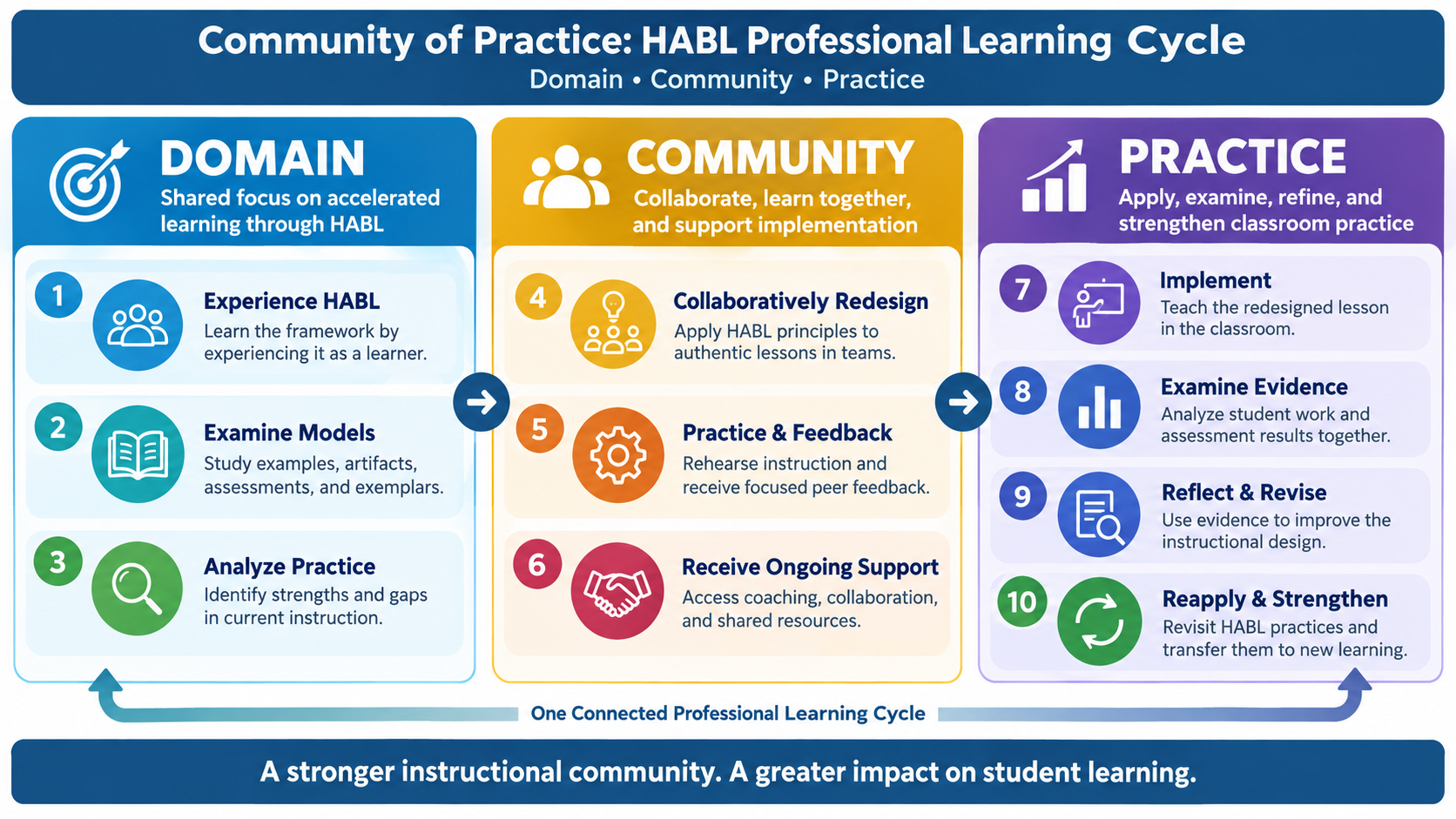
The unique challenges faced by teachers under a 5x5 accelerated instruction schedule are myriad and difficult to address. Unfortunately, the district provided no professional learning to manage these challenges. During my matriculation in this Master's program, I developed a framework to address the issue at hand, but specific professional development and learning approaches are needed to achieve effective results in this context. Communities of Practice, which Wenger-Trayner and Wenger-Trayner (2015) define as groups of people who share a concern or passion for something they do and learn how to improve that practice through regular interaction, work because the three essential components — Domain, Community, and Practice — work together beyond single-session trainings and are teacher-focused to ensure continuing skill development and action planning without the need for time-intensive interventions. It also provides an explicit structure for the professional learning: Domain is accelerated instruction; Community is the teachers, specialists, and department chairs; Practice is the integration of the HABL framework to increase retention, provide depth, and increase transfer while providing evidence of mastery.
Fit With the Professional Learning Need

The professional learning need isn’t something as banal as using sentence stems, which is actually the campus initiative this year, or even learning a new framework; it is to develop the ability to redesign instruction while increasing accountability and maintaining standards at a time when teachers have less time for reteaching, retesting, intervention, and recovery from chronic student absenteeism.
Because the year is compressed into a single semester and new students rotate into classes twice a year, the issue is one of instructional design. Accelerated instruction requires teachers to rethink what is essential, how students process information, how generative learning increases knowledge, what constitutes evidence of student success, and how pedagogical and TPACK decisions can be adjusted quickly enough to scaffold and spiral teaching effectively within days, not two or six weeks. Although the HABL framework, which is organized around the instructional cycle of Physical Input → Physical Encoding → Digital Artifact → Digital Assessment → Metacognition, seeks to address some of the specific concerns teachers have around this type of instructional constraint, a predetermined set of procedures isn’t enough to give teachers who need to make significant progress with students on a compressed timeline.
A Community of Practice fits this need because it allows teachers to continually make informed, supported judgments about curriculum, pacing, student artifacts from the HABL framework, formative assessment (including benchmarks and certification pretests), intervention, and mastery. Wenger-Trayner and Wenger-Trayner (2015) state that communities of practice allow teachers not only to exchange existing knowledge but also to solve problems, develop resources, and create new practices necessary for their students' success; therefore providing a clear structure in which educators can implement HABL approaches, effectively gather data and create action plans, discuss evidence with colleagues and implement changes, and refine their pedagogy in real time, not over time.
I am proposing this with a caveat. Communities of Practice are a long way from being a cure-all. Although Ventista and Brown's (2023) systematic review of 125 studies found that supporting ongoing coaching and collaborative continuing professional development that occurs frequently and over longer periods appears more promising than isolated professional development events, they did find that learning communities alone, when applied casually, did not establish a definite impact on student outcomes. Communities of Practice is not the stick that beats down all the problems of accelerated learning or any other significant paradigm shift, but the carrot that creates the conditions for collaboration that encourages teachers, improves implementation and practice, and builds capacity in learners and their students.
Fit With the Participants
Wenger-Trayner and Wenger-Trayner's (2015) concept of a shared practice elevates Communities of Practice beyond the traditional expert-to-participant professional development we have today. A teacher’s practical knowledge is a resource that should be shared and developed rather than isolated in their classrooms and only observed during walkthroughs and T-TESS observations. Teachers are the most important and influential contributors to professional knowledge. Working in a community not only strengthens this contribution but also builds a deep repertoire of tools, experience, strategies, and approaches.
Dzieciatko-Szendrei et al. (2024) found that teacher communities are characterized by interaction among participants, knowledge exchange, and collective practices aimed at improving teaching and learning. Their findings are essential to this design approach. Assigning teachers to a group or labeling an existing meeting as a Community of Practice won’t work. The community must have a genuine connection to its participants and their practice, and a structured approach to the problems and to the group itself. By honoring participants and respecting their knowledge and experience within a community they feel comfortable in, real progress can be made.
Fit With the Organizational Context
A Community of Practice is well-suited to this organizational context because accelerated instruction represents a change in the system and not the work. Even though the instructional calendar has been compressed, every school from Middle to High School is implementing the same change. The district and school organization is still responsible for accountability compliance and for increasing their TEA ratings. PLCs have proven ineffective time and again for structural organizational change, and other static models don’t have the mechanics built in to address the problems that emerge at the speed and frequency accelerated learning creates. Learning Forward's (2025) Standards for Professional Learning, particularly the Culture of Collaborative Inquiry standard, underscores continuous improvement, collaborative capacity, and shared responsibility for improving student learning. If we look more closely, the Learning Designs standard calls for professional learning that is contextualized, grounded in research, connected to participant needs, and structured to support sustained implementation. Furthermore, the Implementation standard further stresses long-term support, feedback, change management, and the sustained use of new practices. All of these can be addressed by the organization’s support, particularly the Office for Professional Development, and through the careful, structured use of Communities of Practice. Because the organization itself is presenting the change, creating this approach supports the organization while ensuring the change does not happen to its detriment.
Fit With the Desired Change in Practice

Because the desired change is in instructional practice rather than in compressing traditional instruction, Communities of Practice is my best choice for a professional learning approach. It shifts the emphasis from covering TEKS and prepping for tests to creating systems that preserve depth, retention, transfer, and mastery, and in my case, implementing a framework that allows the teacher to do so by examining student artifacts and formative evidence during instruction rather than waiting for summative assessments and benchmarks to do so.
For that reason, the Communities of Practice should center on evidence of implementation and learning rather than collaboration for its own sake or static meetings and follow-ups. The Community of Practice would serve as the professional learning and implementation structure for HABL, while HABL would serve as the instructional design framework. This creates a direct relationship between professional learning, classroom practice, evidence, reflection, and refinement, which is necessary for creating an environment where the HABL framework is not a disconnect, fly-by-night idea someone picked up at a convention, but an evidence-based approach to helping teachers address a real-life need in real time and continuing learning in a supportive, respectful, and research-based climate that leverages all of the strengths, appreciates the teachers' time and ability, and leads to significant instructional and institutional change. This represents not only a change in the teacher’s practice but also in the entire organization's practice.
The Professional Learning Experience
Artificial Intelligence and Professional Learning
AI would not be necessary for this model of in-person meetings and sharing; however, with certain guidelines, the use of AI would be encouraged to create meeting artifacts that provide evidence and track growth. The specific guidelines I would implement would be:
AI use is encouraged for data disaggregation (numbers only) but not for data collection, organization, or creation. Student names, Teacher names, ID numbers, or any information that can identify an individual may never be entered into an AI model, whether online or on a local computer. Use of AI in this manner is strictly prohibited and violates HIPAA, FERPA, and the district AUP.
Please use AI to enhance and speed up the creation of classroom artifacts; however, generative learning must be respected, and AI may not replace genuine creation in the class or the meetings.
Please disclose all AI use and require students to do the same.
These are simply best practices for implementing AI in an academic setting.
AI Disclosure:
AI was used to create the graphics and to compile, verify, and re-verify the sources used in this post. Also, Grammarly was used to ensure compliance with proper writing mechanics. All ideas and research, as well as the HABL framework and writing, are the work of the original author.
References
Dzieciatko-Szendrei, B., Pantić, N., Joksimović, S., Gašević, D., & Viry, G. (2024). Systematic review of the operational definitions and indicators of teacher communities. Educational Research Review, 45, Article 100640. https://doi.org/10.1016/j.edurev.2024.100640
Learning Forward. (2025). Standards for professional learning (2025 ed.). https://standards.learningforward.org/standards-for-professional-learning/
Ventista, O. M., & Brown, C. (2023). Teachers' professional learning and its impact on students' learning outcomes: Findings from a systematic review. Social Sciences & Humanities Open, 8(1), Article 100565. https://doi.org/10.1016/j.ssaho.2023.100565
Wenger-Trayner, E., & Wenger-Trayner, B. (2015). An introduction to communities of practice: A brief overview of the concept and its uses. Wenger-Trayner. https://www.wenger-trayner.com/introduction-to-communities-of-practice/
