
HABL: Leadership, Implementation, and Ongoing Support
HABL for Accelerated Classrooms

1. Leadership Roles and Responsibilities
Initial Leadership: HABL Teacher-Leader
The initial instructional leader presenting should be a teacher-practitioner, facilitator, model, and coach who is already knowledgeable and experienced with the HABL framework, as the initiative is centered on classroom practice. The initial leader must be able to demonstrate how HABL operates in authentic accelerated-classroom conditions rather than presenting the framework in theory (Bambrick-Santoyo, 2018; Learning Forward, 2025).
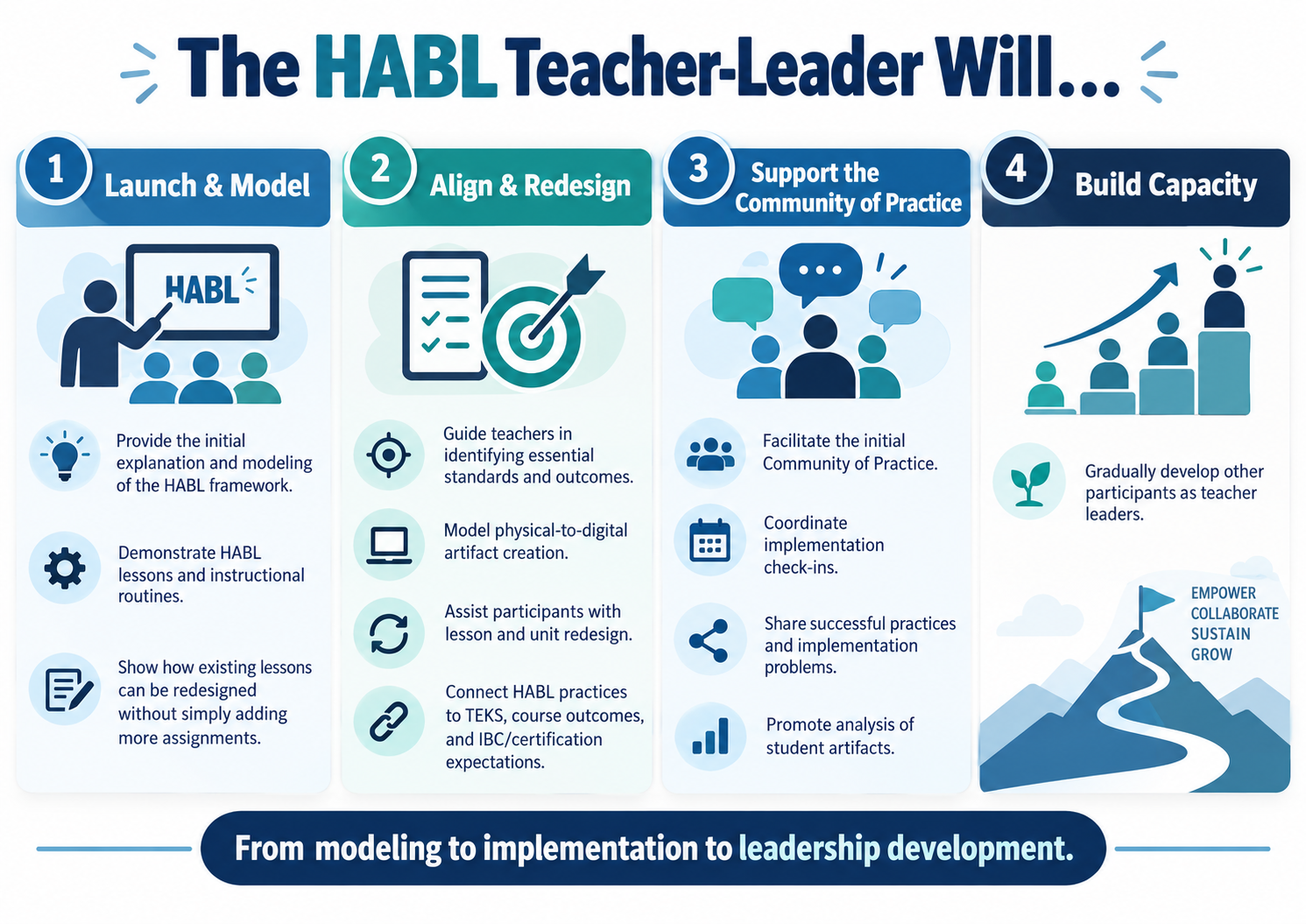
The main functions of the HABL Teacher-Leader
Campus Administrator: Sponsor and Organizational Leader
The campus administrator will support the initiative but will not serve as the primary instructional facilitator, as the administrator must work as a manager, connecting the classroom to the broader asset systems needed to ensure the teacher’s success. There must be a distinction, and the delineation is important. The HABL Teacher-Leader provides the instructional expertise, while the administrator creates the conditions that enable professional learning to become actual pedagogical practice. Each person will work most efficiently in the environment where they have the most influence.
Therefore, the administrator will:
communicate visible support for the initiative;
protect collaboration and professional learning time;
connect HABL to campus instructional priorities;
help remove organizational barriers;
coordinate access to resources;
protect space for experimentation and revision;
ensure that implementation is not reduced to a compliance checklist;
use teacher and student evidence to inform organizational decisions.
Instructional Coaches, Department Leaders, and District Curriculum and CTE Leaders
These leaders will provide ongoing implementation support by emphasizing evidence, action, implementation, and revision, rather than evaluation. This will enable these essential leaders to prepare teachers to implement a uniform, standards-aligned instructional model that strengthens TEKS mastery, supports IBC/certification outcomes, and aligns pacing and assessment with district benchmarks.
Community of Practice Members
Because the structure is based on Communities of Practice, participating teachers will not passively sit through professional development. Instead, they will identify authentic problems of practice and redesign existing lessons by implementing HABL routines. They will also bring student artifacts to CoP meetings and share successful and unsuccessful attempts. This will allow them to analyze evidence collaboratively, provide peer feedback, and develop instructional resources in real time. Then, they can also contribute exemplars for data and duplication and reflect on changes in student learning (Wenger-Trayner & Wenger-Trayner, 2015).
Emerging HABL Teacher-Leaders
As participants gain expertise and build and share their experience, selected teachers will be able to take on additional leadership responsibilities. They can facilitate CoP meetings, model lessons, lead artifact analysis, support their colleagues, create new workflows across disciplines and classes, mentor new teachers, and create and contribute to a resource database and repository for all teachers to draw on. Therefore, leadership naturally shifts from the HABL Teacher-Leader to the collaborative group, and from the group to a more distributed, teacher-based leadership structure supported by the administration.
2. Implementation and Ongoing Support
Implementation Premise
This PLLP addresses the accelerated instruction model, which poses challenges for teachers in maintaining depth, retention, application, feedback, revision, and transfer within a compressed calendar. It is more than just teaching faster; it relies on changing pedagogy to meet the unique demands of teaching a traditionally year-long course in a single semester. So, the initial implementation will present HABL materials, physical workbooks, digital assignments, work-product artifacts, and formative assessments aligned to TEKS expectations (as well as other IBC, AP, or state test standards), organized as a Community of Practice rather than just a one-time workshop. Participants will learn HABL, implement it, gather evidence and data, revise their practice, and add their own collective expertise to the development of the framework (Fiorella & Mayer, 2015; Wenger-Trayner & Wenger-Trayner, 2015).
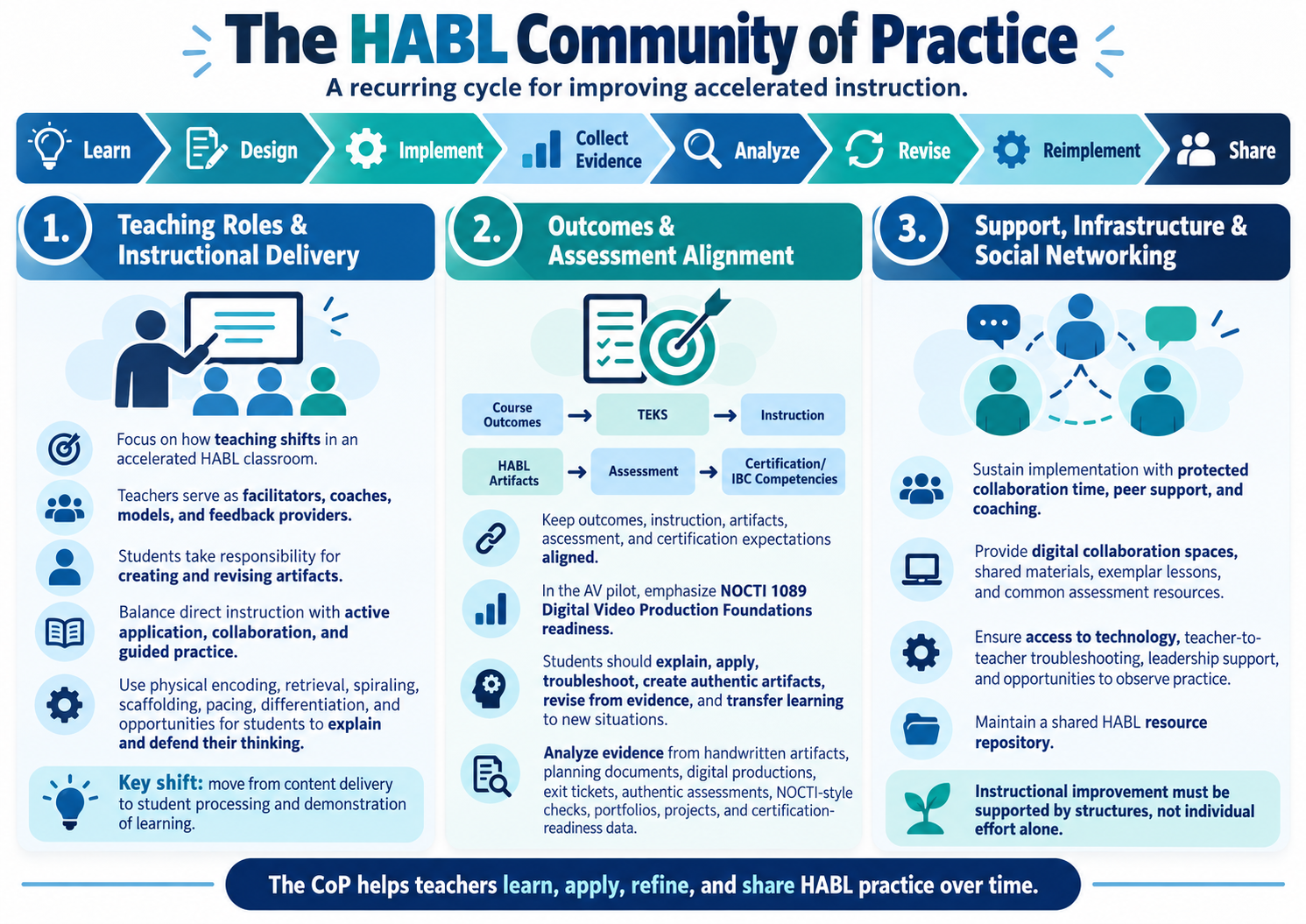
The three domains that govern HABL Communities of Practice
The HABL instructional process remains:
Physical Input → Physical Encoding → Digital Artifact → Digital Assessment/Feedback → Metacognition, Revision, and Transfer (Fiorella & Mayer, 2015; Mishra & Koehler, 2006; Zimmerman, 2002).
Ongoing Evidence and Support Cycle
During implementation, the participants will use a two-week evidence cycle during which teachers will bring evidence of assessment performance and student artifact completion. They will be able to identify gaps, recognize patterns, and revise practices to improve quality. This will also be a time to address attendance and work-completion concerns and to gather data from implementation observations woven into standard walkthroughs.
The Community of Practice can then use the evidence to determine what students actually earned, where the learning broke down, what contributed to the breakdown, what needs to be retaught and how, and what should be kept for the next two-week cycle and what should be removed.
This can lead to responses to instructional issues that are relevant and data-driven. The teachers can create small-group reteaching, revised directions, scaffolding, and reassessment. They can also adjust their modeling, create and provide clearer exemplars, and regroup students as needed. This is a powerful tool for success. This structure keeps HABL fluid and not a collection of worksheets and Edpuzzles. HABL and the CoP are adaptive systems driven by data and evidence of learning.
3. Timeline and Sequence
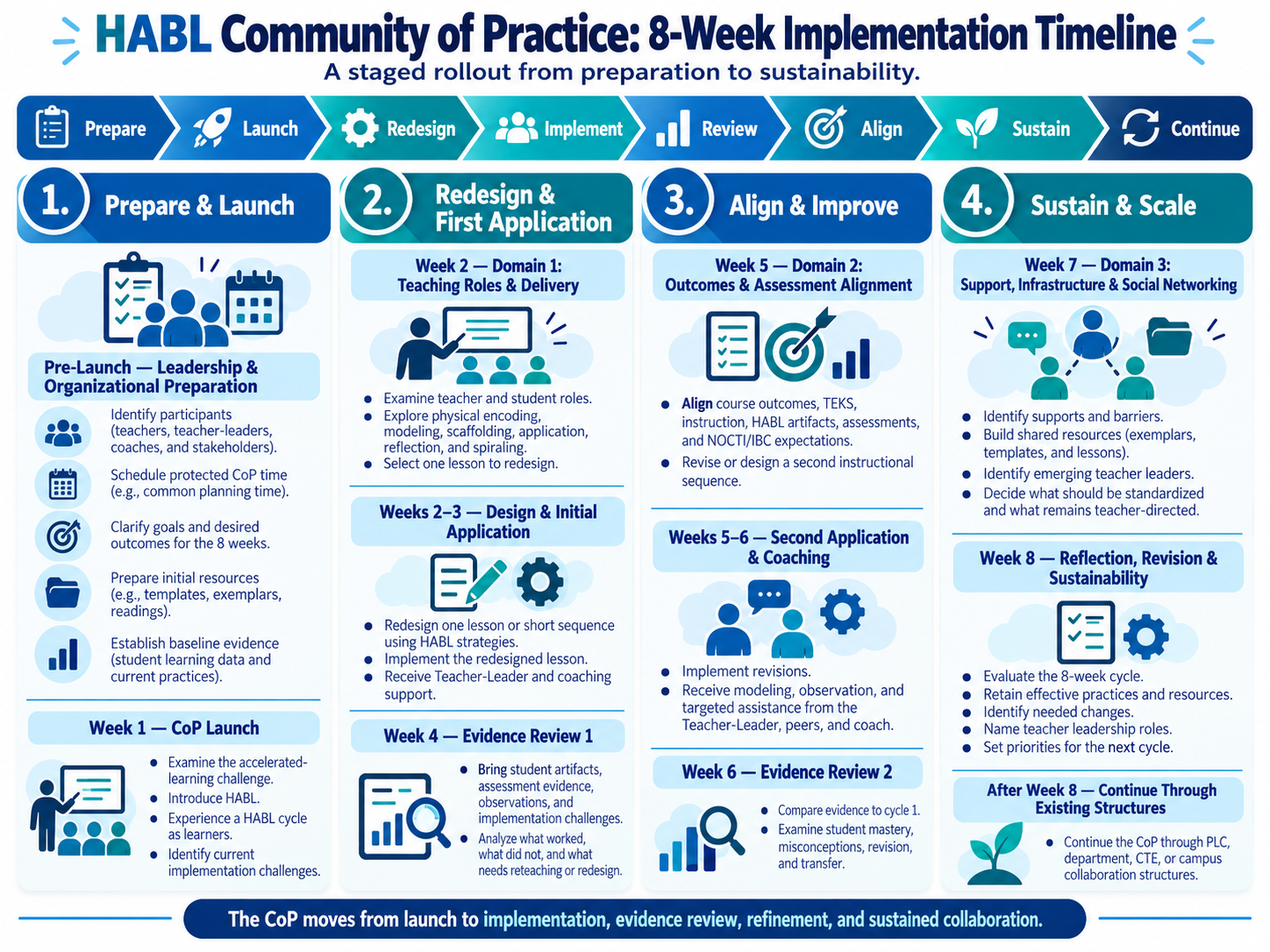
The initial professional learning cycle will be eight weeks using the Community of Practice as the central professional learning structure. The intent is not to have a permanent extra meeting requirement. Instead, HABL conversations become embedded in existing professional routines such as PLCs and department meetings.
4. Communication
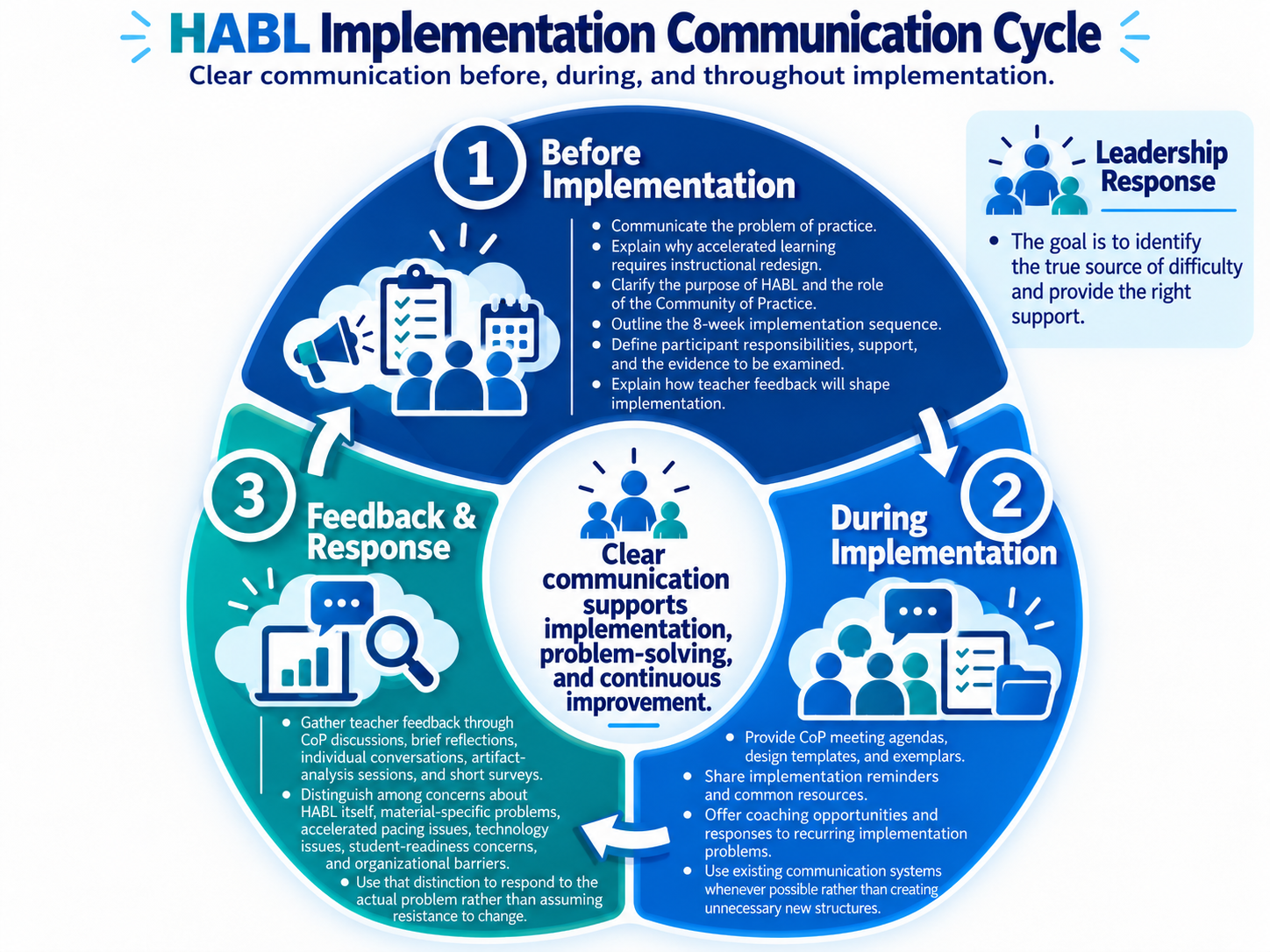
Communication will emphasize from the beginning that HABL is not being added to teachers' workload, but rather a framework for redesigning the work teachers and students already do so that accelerated instruction doesn’t adversely affect accountability metrics but provides deeper evidence of learning, retention, revision, and transfer.
5. Time, Resources, and Organizational Support
Protected Time
Teachers will need protected time for initial framework learning and lesson redesign. They will also need time for meetings during which coaching, artifact analysis, and reflection and revision will occur. Existing structures and meetings, as well as district PD opportunities, should also be used whenever possible.
Resources: Existing HABL Materials
The initial AV class implementation already includes substantial instructional materials. Approximately 140 students are already using HABL workbooks that are over 90 pages long, with 45 pages on the front and back, making large-scale reprinting unrealistic. Therefore, implementation improvement will prioritize easy-to-reproduce teacher presentation materials, digital supplements, digital exemplar artifacts, specific teacher guides, and supplemental instructional resources. This is easier to accomplish than replacing the myriad of materials students already possess.
Resources: Technology
HABL's power lies in the interaction between physical and digital learning, but it should not depend on a single technology platform.
Resources may include:
learning-management systems;
digital assessment tools;
production software;
student devices;
shared digital workspaces;
portfolio systems;
classroom production technologies.
Technology reinforces learning; it does not define HABL or replace instruction.
Instructional Resources
Teachers will need access to:
HABL planning templates;
artifact exemplars;
course standards;
TEKS;
certification competencies;
formative-assessment resources;
student reflection structures;
common rubrics;
intervention resources.
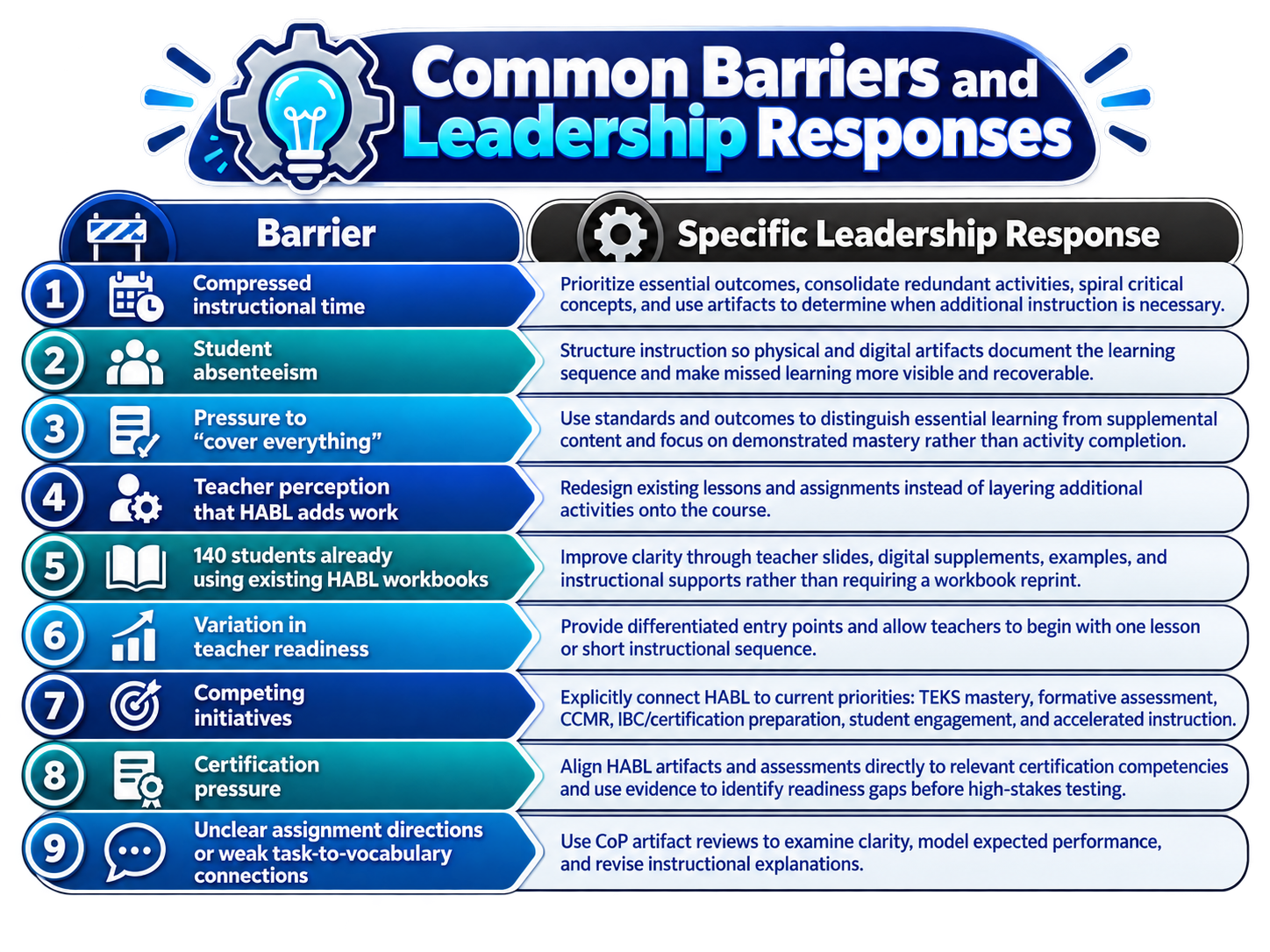
6. Anticipated Barriers and Leadership Responses
With HABL implemented in the current AV1 and AV2 classrooms, the anticipated barriers are known, and responses have already been developed and put in place. This is a massive boon to the work and provides a clear path to improving the PLLP, practice, and implementation.
7. Sustainability
Sustainability will depend entirely on embedding HABL into the existing PLC and meeting structures, rather than keeping it as a separate initiative. After the eight-week cycle, the Teacher-Leader will transfer responsibilities to emerging teacher leaders, create distributed ownership, and reduce dependence on the one-person, one-leader model of the past. Also, creating a shared repository of templates, exemplars, assessments, and aligned resources should meet the standard Bates (2015) set as a professional learning system that is continually updated. This move toward teachers who take ownership of learning, implementation, and leadership meets what Zimmerman (2002) describes as a self-directive process. This move makes the effort a more focused, long-term endeavor that will support the entire school organization well after the initial training.
AI Disclosure:
AI was used to create the graphics and to compile, verify, and re-verify the sources used in this post. Also, Grammarly was used to ensure compliance with proper writing mechanics. All ideas and research, as well as the HABL framework and writing, are the original author's work.
References
Bambrick-Santoyo, P. (2018). Leverage leadership 2.0: A practical guide to building exceptional schools. Jossey-Bass. Wiley Newsroom
Bambrick-Santoyo, P. (2019). Driven by data 2.0: A practical guide to improve instruction. Jossey-Bass. https://doi.org/10.1002/9781119564614 Wiley Online Library
Bates, A. W. (2015). Teaching in a digital age: Guidelines for designing teaching and learning. Tony Bates Associates Ltd. BCcampus Open Publishing
Fiorella, L., & Mayer, R. E. (2015). Learning as a generative activity: Eight learning strategies that promote understanding. Cambridge University Press. https://doi.org/10.1017/CBO9781107707085 Cambridge University Press
Learning Forward. (2025). Standards for professional learning (2025 ed.). Learning Forward
Mishra, P., & Koehler, M. J. (2006). Technological pedagogical content knowledge: A framework for teacher knowledge. Teachers College Record, 108(6), 1017–1054. https://doi.org/10.1111/j.1467-9620.2006.00684.x Sage Journals
Mueller, P. A., & Oppenheimer, D. M. (2014). The pen is mightier than the keyboard: Advantages of longhand over laptop note taking. Psychological Science, 25(6), 1159–1168. https://doi.org/10.1177/0956797614524581 PubMed
Wenger-Trayner, E., & Wenger-Trayner, B. (2015). An introduction to communities of practice: A brief overview of the concept and its uses. Wenger-Trayner. Wenger-Trayner
Zimmerman, B. J. (2002). Becoming a self-regulated learner: An overview. Theory Into Practice, 41(2), 64–70. https://doi.org/10.1207/S15430421TIP4102_2
