
HABL for Accelerated Learning: Designing for Depth, Retention, and Transfer in a Compressed Semester
I. Context, Need, and Leadership Challenge
A. Educational and Organizational Context
This learning initiative is specific to the accelerated school environment where a traditionally year-long class is taught in a single semester and on a 5×5 block schedule that meets every day.
In this model:
there is no change to the curriculum, and the TEKS are still addressed in the semester;
instructional days are compressed into a single semester comprising 80 instructional days in the fall, and 87 days in the spring;
the classes are necessarily faster-paced, and absences have a greater impact than in previous school years;
teachers have less time for reteaching and retesting, and require more time to plan and assess.
The challenge is how to increase retention and improve student outcomes with a compressed instructional schedule while still meeting all accountability metrics (STAAR, IBCs, CCMR, TSIA) required by TEA and the school district.
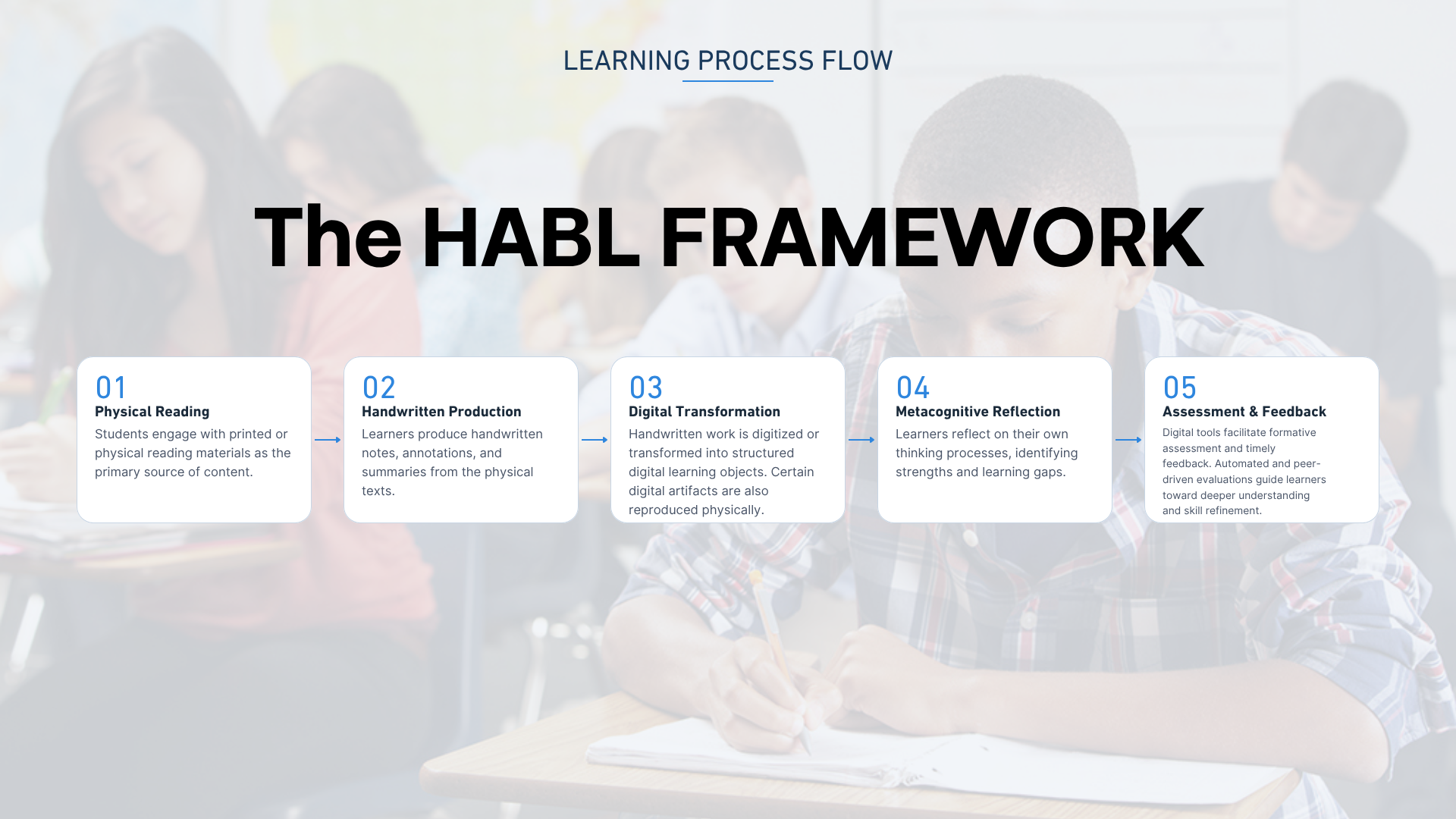
The proposed professional learning initiative will introduce the Hybrid Artifact-Based Learning (HABL) framework as an instructional design approach for addressing this challenge.
Problem of Practice:
If teachers apply traditional pacing approaches in their accelerated classrooms, several issues will inevitably arise. There won’t be many opportunities to scaffold or spiral lessons; students won't have time to generate learning and may only cover important material superficially; and reteaching opportunities would be difficult given the fall and spring assessment schedules and shutdowns. To that end, teachers need professional learning in intentional instructional design in accelerated classrooms rather than just compressing what they already do.
What Is Currently Known/Observed
The courses must cover all necessary TEKS and IBC standards to prepare students for the assessments.
Accelerated courses are all about:
What really matters;
How quickly it can be covered;
How concepts are assessed and how data is collected;
What is the process of intervention, and how EBs and SPED students are supported;
How do students practice the material and prepare for the tests?
Although some students will get more time in classes because the 5x5 schedule means the teachers see them every day, other students who were already in blocked classes will lose over 100 instructional days and still be required to cover the same amount of material.
Students have already lost credit for classes just before the progress report due to absences because each instructional day carries more weight under the accelerated schedule.
Teachers are accountable for student outcomes even though the campus is on a compressed calendar.
Why the Need Matters
The issue affects several groups. It overloads students who now have classes every day, limited opportunities to recover from negative outcomes, and reduced retention due to the pace of instruction. It forces teachers to choose between covering the material and moving students to mastery, and to design instruction in a vacuum because there is no time for DDI initiatives to take effect. It also forces the campus to remain accountable for instruction and accountability that does not count for years afterward because CCMR data takes longer to gather and disaggregate than STAAR assessment data. This may cause a dip in instructional quality if everyone in the organization works on their own without knowing where the data is pointing them.
Why Professional Learning Is an Appropriate Response
Professional learning is appropriate because it’s not about scheduling but instructional design in the confines of the accelerated course.
Teachers need the opportunity to reassess their instructional design, figure out what is essential and what is not, examine how students are processing, generating, and retaining information, redesign based on a new paradigm of evidence and data, use PLCs to create common approaches around assessment, pacing, and curriculum, and gain student work samples to see what students are actually learning and what is falling through the cracks. This means that professional learning should be an implementation cycle rather than a single presentation at the start of the year. Professional learning is specifically designed for this purpose.
Emerging Leadership Challenge
With all of the issues in mind, the central question is: How can instructional leaders support teachers in designing instruction for accelerated courses to mitigate the negative effects of less time for teaching while maintaining rigor, relevance, and the quality of learning?
This means that leadership needs to build teacher capacity and agency to make better decisions about processing, generation, assessment, and fundamentally what mastery looks like, while maintaining the instructional quality that existed before the change.
II. Participants, Stakeholders, and Professional Learning Goals
A. Primary Participants
Primary participants would include teachers, instructional specialists, and administrators due to the need to deliver instruction, support teachers, and conduct observations.
B. Current Understanding of Participant Context
There are only 5 people in the district who have ever taught an accelerated class in this context and on a 5x5 schedule, and they only have this experience because it was piloted last year in their classes. Not one of those teachers presented their experience in any capacity before the initiative was implemented across every secondary campus. The anxiety is high, and no one has any answers.
Since my professional learning initiative is based on the HABL framework, there is an opportunity to demonstrate that existing instruction can be organized around this framework without creating a new set of assignments for teachers to deliver and grade. I hope this will alleviate anxiety and foster buy-in from teachers and administrators without requiring massive instructional overhauls.
C. Additional Stakeholders
Potential stakeholders include:
campus administrators;
instructional coaches;
department chairs;
CTE leadership;
curriculum and instruction personnel;
counselors;
special populations staff;
testing/certification coordinators;
students;
district leadership.
Stakeholder support may be needed for:
scheduling;
technology;
assessment data;
III. Initial Professional Learning Goals
Goal 1 — Understand Accelerated Learning Design
Participants will understand the difference between accelerating learning and teaching more content faster
Goal 2 — Understand and Apply HABL
Participants will understand the HABL instructional cycle: Physical Input → Physical Encoding → Digital Artifact → Digital Assessment → Metacognition
Goal 3 — Design Evidence-Rich Learning
Participants will redesign instructional units so that students regularly produce digital and physical artifacts aligned with the HABL Framework that demonstrate understanding, skill development, and transfer.
Goal 4 — Use Formative Evidence to Adjust Instruction
Teachers will use student-created artifacts as real-time evidence of learning rather than relying on benchmarks and unit tests. This will allow them to identify who understands, where the gaps are, and which students need support and intervention.
Goal 5 — Build Metacognition Into Accelerated Instruction
Teachers will build in structured opportunities for students to engage in metacognitive reflection, identify their misconceptions, self-evaluate, revise their work, and explain how their learning connects to prior knowledge.
IV. Desired Participant Outcomes
If I structure this Professional Learning Plan like my lesson plan, then:
See: This introduces the principles of HABL, the characteristics of effective accelerated instruction, and the differences among student mastery, skill development, and TEKS coverage.
Do: I’d like the teachers to experience HABL from a learner's perspective, work together to redesign their curriculum, experience artifact creation in context, give feedback, and participate in the reflection and revision cycle.
Talk: Teachers would be able to discuss and articulate why a reimagining of instructional design is necessary rather than a re-pacing of content, how creating artifacts makes learning and thinking tangible, how physical and digital learning can work together to create a rich learning environment that increases retention, and why coupling this with well-designed formative assessment evidence is important.
Transfer: Teachers would then take the HABL Framework along with their course outcomes and map progress across an accelerated semester, redesign using HABL, model the creation of physical and digital artifacts for their classes, use the artifacts as tools for assessment, adjust instruction based on sound DDI principles, and build reflection and metacognition into their instructional cycles.
V. Initial Leadership Outcome
The broader goal is to create an instructional leader who can intentionally design learning that preserves depth, rigor, relevance, and evidence of mastery despite the reduction in instructional time under the current system. A prepared leader is one who is transformative and builds teachers' capacity to respond to the rapid changes in an accelerated 5x5 classroom, and this professional learning can facilitate that.
